
Surface Modifiers
🔍 Search for specialty additives solutions
Arkema surface modifiers portfolio
Solutions designed to control surface properties
Arkema offers a comprehensive range of surface modifiers and functional agents that act through controlled surface modifying mechanisms. These solutions are suitable for various coatings applications, helping improve surface quality, processing robustness and long-term performance on multiple substrates.Crayvallac® surface modifiers
The Crayvallac® technology portfolio provides advanced surface modifiers designed to fine-tune surface behavior in demanding coating applications. Based on carefully engineered polymer and wax-based chemistries, Crayvallac® solutions act at the coating surface to control slip, scratch resistance, abrasion resistance and surface durability without compromising bulk formulation properties. These surface modifiers are widely used to improve application robustness, surface quality and long-term performance across industrial, protective and decorative coatings.
Key benefits
- Improves slip and friction control without impacting bulk rheology
- Enhances abrasion, scratch and mar resistance for longer coating durability
- Delivers reliable surface performance with minimal effect on curing or intercoat adhesion
- Compatible with waterborne, solventborne and high-solids systems
Main applications
-
Industrial and protective coatings for metal and plastic substrates
- Decorative and wood coatings requiring improved surface durability and appearance
- High-solids and powder coatings where surface control is critical

CRAYVALLAC® WN-1535 is a modified polypropylene wax designed for easy dispersion, delivering effective matting with good transparency. It enhances scratch and abrasion resistance while maintaining reliable surface performance, making it well suited for coatings where durability and appearance must be balanced.
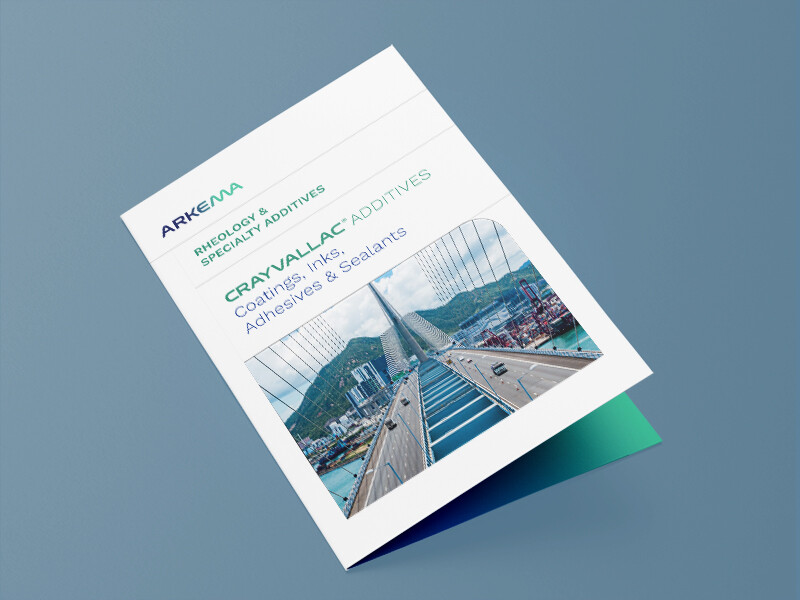
Download our surface modifiers brochure
More technical information about surface modifiers
-
CRAYVLLAC® WN-1535: NEW VERSATILE MATTING WAX
How surface modifiers improve coating application and film quality
Surface modifiers are additives designed to act primarily at the coating–air and coating–substrate interfaces, rather than in the bulk of the formulation. Their role is to adjust surface-related properties—such as slip, friction, abrasion resistance and surface durability—without significantly altering viscosity, curing behavior or internal film structure. From a formulation standpoint, surface modifiers work through a physical, non-reactive mechanism. After incorporation into the formulation, they remain well-dispersed during processing and application. During drying or curing, they migrate selectively toward the surface of the coating film, driven by differences in surface energy between the additive and the surrounding binder matrix. Once at the surface, they orient themselves to form a thin, discrete surface-enriched layer that governs the final surface behavior of the coating. This controlled migration and orientation is critical: it allows surface modifiers to deliver targeted performance benefits—such as reduced friction or improved scratch resistance—while preserving bulk mechanical and adhesion properties.
Key benefits in liquid coatings
In liquid coatings, CRAYVALLAC® surface modifiers are used to fine-tune both appearance and durability:
- Matting, slip, anti-abrasion & anti-scratch
- Water and chemical resistance, anti-blocking, sanding aid
- Silica reduction and useful aid for silica dispersion, orientation & anti-settling
These benefits allow formulators to adjust surface properties late in development without redesigning the binder system.
Key benefits in powder coatings
In powder coatings, CRAYVALLAC® additives contribute both to processing and final surface quality:
- Processing-flow improvement for extrusion
- Flow & levelling
- Degassing specially in primid systems
- Texturing & matting
- Special effects (silky aspect)
- Post extrusion addition
Specific mechanism of CRAYVALLAC® surface modifiers
CRAYVALLAC® surface modifiers are based on engineered synthetic waxes and modified polymer architectures, specifically designed to provide predictable and durable surface effects. Their chemistry and physical form are optimized to balance three key parameters: compatibility, mobility and surface activity.
- First, CRAYVALLAC® additives are formulated to be highly compatible with a wide range of binder systems, including waterborne, solventborne and high-solids coatings. This compatibility ensures stable dispersion in the formulation and prevents unwanted effects such as haze, poor gloss or phase separation.
- Second, during film formation, CRAYVALLAC® particles exhibit controlled mobility, allowing them to migrate toward the surface at the right stage of drying or curing. This controlled behavior is essential to avoid excessive blooming or uneven surface distribution.
- Finally, once positioned at the surface, CRAYVALLAC® wax structures provide mechanical reinforcement at the micro-scale. By forming a lubricating and protective layer, they reduce surface friction, improve abrasion and scratch resistance, and enhance resistance to wear and marking. Importantly, because this mechanism is physical rather than chemical, CRAYVALLAC® surface modifiers do not interfere with crosslinking reactions or curing kinetics.
Why this mechanism matters for formulators
The CRAYVALLAC® approach allows formulators to fine-tune surface performance independently from bulk formulation design. This makes surface modifiers powerful finishing tools that can be adjusted late in formulation development to address specific issues such as scratch resistance, slip or surface durability—without requiring changes to the binder or curing system. As a result, CRAYVALLAC® surface modifiers are widely used in industrial, protective and decorative coatings where surface performance, durability and application robustness are critical to end-use performance and service life.
Often asked questions to our experts
The selection of a surface modifier is driven by the targeted surface effect (slip, matting, scratch or abrasion resistance), the coating technology (liquid or powder) and the binder system. Interactions with other additives and curing conditions must also be considered.
Wax- and polymer-based surface modifiers are typically used to fine-tune surface performance without affecting bulk properties. CRAYVALLAC® surface modifiers offer a range of chemistries and formats to address these requirements across multiple coating applications.
CRAYVALLAC® surface modifiers are available as micronized wax powders or as dispersions of micronized waxes in water or organic solvents. Powders are commonly used in powder coatings, while dispersions facilitate easy incorporation into liquid coatings, ensuring uniform distribution and reliable surface performance.