
Reactive Acrylic Copolymers for use in Low Extractable Coatings

Self-Reactive copolymer resins are acrylic copolymers which contain photocurable functionality on their backbone.
Reactive Acrylic Copolymers can eliminate extractables (low migration) and odor related to traditional photoinitiators. They allow for simplified processing by eliminating the need to dissolve traditional photoinitiators into resin. They can also be used as their own curable films or be formulated to function as polymeric photoinitiators.
Performance attributes
- Requires no added photoinitiator
- Copolymers can provide a solution to applications where low shrinkage and adhesion are desirable
- Acrylic backbone has good compatibility with acrylate monomers/oligomers
- Customizable performance based on monomer choice
- High molecular weight of copolymer further contributes to low migration
Traditional copolymers used in UV/LED coatings
| Non-reactive Polymer (IPN after UV Cure) |
|---|
 |
|
| Acrylated Acrylic Polymer (Single Network After Cure) |
|---|
|
|
New reactive copolymers performance
In our new reactive copolymers, the chromophore is grafted onto the backbone of the copolymer. This allows us to tailor the chromophore choice to the appropriate UV/LED source.
Customizable design inputs:
- Molecular weight
- Monomers
- Chromophore
- Weight percent of chromophore
Adhesion
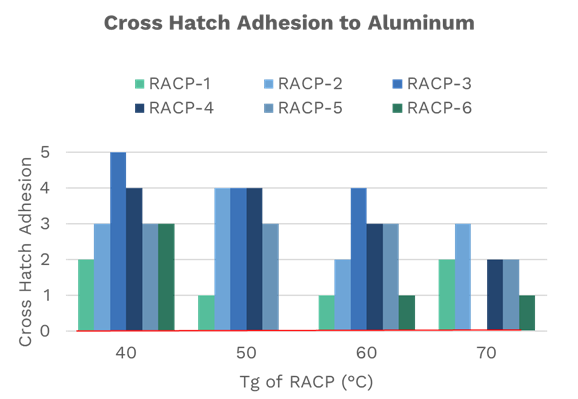
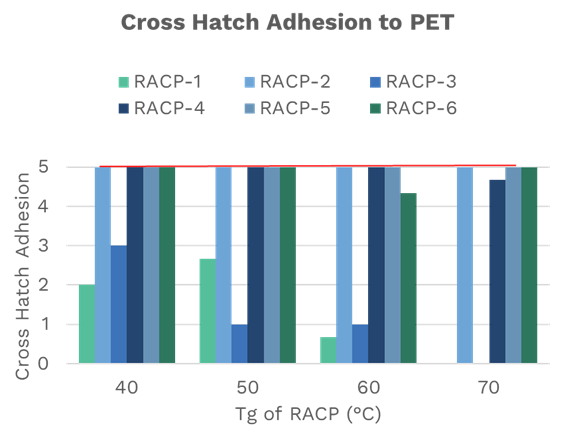
There is a minor decrease in adhesion as Tg increases, this trend is more pronounced in the aluminum samples. The co-monomer choice seems to play a bigger role than the target Tg.
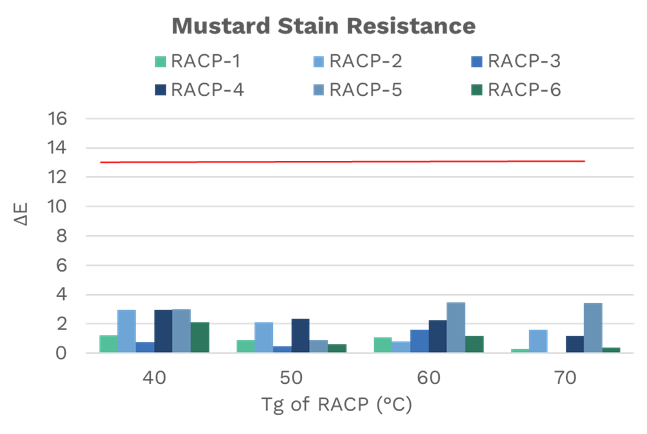
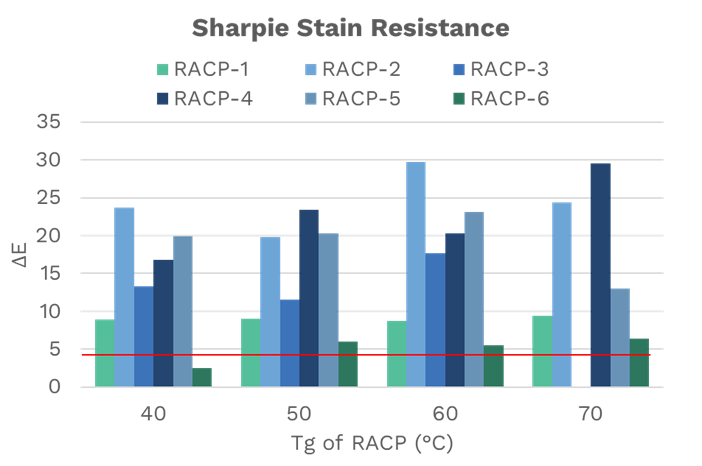
*LTM = Low Tg monomer; HTM = High Tg monomer; RACP = Reactive Acrylic Copolymer / *The control sample is denoted as a red line on graphs
Stain resistance
The RACPs have better mustard stain resistance compared to the control coating. We found that a higher Tg does not equal better stain resistance. There are no clear trends for sharpie resistance however RACP-1 and RACP-3 show the best performance.
Observations and next steps from initial testing matrix
- Tg of RACP does not impact adhesion and stain resistance drastically
- Choice of co-monomer does impact overall performance
- Different RACPs may be suitable for different applications depending on performance requirements
Conclusions and future work
Our new reactive acrylic copolymers are designed to provide the bulk of a coating’s properties since they will be used as a major component in the formulation. We found that different co-monomers can be used to target a specific property. DB conversion via FTIR shows high levels of conversion across all samples, showing that grafting the chromophore onto the copolymer backbone does not inhibit reactivity. These reactive resins can easily be made without chromophore for non-UV/LED applications.